Monday, April 9, 2012

Virtual Representations of the Real


During this journey into Second Life, I am curious as to what places that I’ve been to in real life look like in Second Life to see if the game. The first version of New York that I visited was called “Old New York” – a name that did not fit the landscape which was outfitted with modern skyscrapers contrasted with the Brooklyn Bridge and an area that was supposed to be SoHo. The environment was incredibly disorienting since the music was changing every five seconds. I heard Kanye West as I was in the northern area of the environment, apparently this are was Harlem since “Harlem Lofts” were for rent right next to me. Then there was classical music I heard as I was going over the Brooklyn Bridge, which didn’t make any sense to me at all. Then there was a techno remix of a T-Pain song when I was in the area by the SoHo apartments. Having spent a considerable of time in SoHo and never hearing anything like T-Pain coming out of a storefront, I was thoroughly confused. There was also no one in this area for me to talk to, so I decided to move on. But first here is a beautiful picture showing how poorly designed this version of New York is, with the statue of liberty being on top of the Brooklyn Bridge, next to both SoHo and Harlem. If this was trying to be an accurate representation of the city, the creator must have an elementary understanding of the city. It was ranked high on the popularity scale and said it was a place created by and for New Yorkers, which is why I decided to visit it first. The only thing I was impressed by was the inclusion of a subway system that had multiple stops throughout this rendering of NYC. However, the over ambition in trying to recreate all five boroughs in one area, firstly made no sense, and secondly illustrated that this could never be taken seriously as an accurate representation of New York, and definitely not made for real New Yorkers, but possibly for those that wanted to spend their time and second life money in order to become one.

Overcrowded and busy, but not in the NY sense.
I did more searching for new places to go in virtual New York, and one that especially caught my eye was the 9/11 Memorial. Having lived through 9/11 in Manhattan, it is not a day that I am ever going to forget; however, I am curious to see how such a tragic day is reappropriated for entertainment in second life. While it is supposed to be a memorial, the towers are there in their pre-9/11 form and people are walking around this area like the day never happened. This area is pretty eerie, the soundtrack of the area is very reminiscent of 1950’s songs about love lost which thematically fits, but I would imagine that other music would also fit better if it were closer to the time period. Even though Second Life search said that a few other Second Lifers populated it, I walked around for five to ten minutes and didn’t see anyone in the world. When I called out to the local chat, I was responded by a bot, which answered my questions like a human would, but there was no one around and identified itself as a bot, but only after I asked. I felt very lonely and isolated in this area, and I left shortly thereafter. It looks like it was an area that has a capacity of one in order to be a solo-memorial and not a hang-out space; but with that being said, how proper can a memorial really be while you are walking around with your virtual avatar in a world where the towers still exist and there are few visual markers of post-9/11 change?

Sunday, April 1, 2012

In and Out of My Comfort Zone


After my first experience really getting into Second Life, I decided to take winter’s advice and just search for places to visit and move around a bit. I was about to search for a few cool places to live, but first I saw someone with a kilt on. I decided that I should go up to talk to him maybe he’s Scottish? After starting an introductory conversation, introducing myself and stating that I’m new here. I say – “nice ‘costume’” to be met with the reply “yeah…I’m Scottish, so I wear my kilt J Where r u from [sic]?” My assumptions were correct! On Second Life appearance is key. As Judith Donath and Danah Boyd would say in their “Public Displays of Connection,” Second Life’s major function is as an “environment…in which…new ties are formed and…depictions…[are displayed as] a self-descriptive profile” (72.) By simplifying his Scottish heritage down to the mere visual representative of the kilt. The person to whom I’m talking is illustrating that he doesn’t simply just want people to know of his heritage, but he also wants them to know of it in a way that is explicitly inferred from a quick sighting out of the corner of their eyes.
Simple Representations of the Self
He then asks me where I’m from, and I say my hometown and one of the most well known cities in the USA, New York City. He replies with “Not much of any cultural wear from there L, but I flew out of Newark in January, love lookink [sic] over the water to NYC.” This only goes even further to illustrate that everyone in Second Life is aware of what those around us are wearing, and what it implies both culturally and socially. While ethnic or cultural heritage is not required to be illustrated in order to create a Second Life profile, unlike race or sex, it can be applied to what Nakumura experienced with her travels through LambdaMOO during the research for her essay as heritage can “still being evoked” by certain players through their clothing choices, or lack thereof due to my vaguely Western attire. Then, we were approached by a female user who started to dance and pose for us, after I asked, “Why are you dancing,” she responded with, “I have some problemes [sic] to resolve.” I was unsure of whether she meant that dancing would fix her problems in real life, or if she had other problems in particular, I asked her to clarify; however, I was met with no response, only more dancing. Then my Scottish chat partner went to teleport to another area and I decided to move on myself and leave the tiny dancer alone.

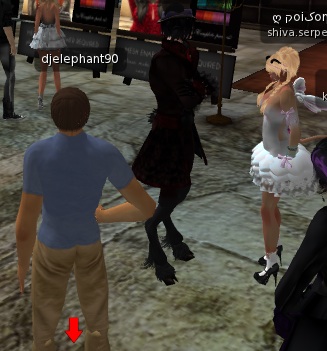
I decided to branch out of my comfort zone a little bit by taking myself to an area that might involve a little bit more fantasy than my welcome area. I teleported to one of the more popular areas called “Wasabi Pills Hair” which focuses “mostly on fantasy and role-playing themes, as well as the latest fashion trends.” It was a perfect place to take me quickly out of my comfort zone. The moment I arrived I was greeted with what sounded like German death-trance music blasting in my eardrums. I felt instantly out of place in my blue shirt and khakis while Goths, pixies and demons surrounded me. I did not realize that this place would be so much darker than I thought. I asked the general group “How out of place am I here” only to be responded by a pink girl with a tail who said “pretty out of place.” I asked for any tips. Another user with a name taken from an Anime series a friend of mine in high school used to watch gave me a few tips on using the second life marketplace to get new accessories like clothing and skin. I then asked if he was into Death Note (the anime) and he said that he was and that I was the second person to get the name reference. He also said, “I wouldn’t guess that from your current outfit.” 

They Think I'm Out of Place. Do You?
Which again reifies the idea that your outfit really gives a lot of power to the other avatars in the game to understand who you are and what you are trying to do in this environment. He added, to be taken seriously in Second Life “you are going to have to invest a little money into it. A good skin, shape and at least one outfit and hair.” Second Life is not just a game to some people; it is a real outlet to play out their fantasies and a place where their interests can be illustrated with as much importance as their skin tones. He then requested that I be his friend so he could give me more help, I was in no position to pass up friends so I accepted. After giving me even more tips on how to get freebies in the world of Second Life to make me look like less of a new kid, he then told me that he would give me a gift of second life money to help get me started. While this was incredibly nice, I declined as I didn’t want to accept what he intended to use on himself; however, after I declined his offer, he still gave me the money – 2,000 Second Life dollars. Even though that amounts to only US$ 8.37, it was still extremely generous of him and further went to exemplify that I would be unsuccessful in the game if I had the visual markers of someone who was new. I’ll take this money and shop wisely for something cool, a journey I will take you on in the next post.  

Sources: 

Donath, Judith, and Danah Boyd. "Public Displays of Connection." BT Technology
Journal 22.4 (2004): 71-82. Print.
Nakamura, Lisa. "Race In/For Cyberspace: Identity Tourism and Racial Passing on
the Internet." University of California, Irvine Department of Humanities. Web. 11 May 2011. 

Wednesday, March 28, 2012

My First Step Down The Rabbit Hole


Welcome to my introduction to Second Life. I’ve only been in this environment once before as part of an online discussion in a digital media class, but never before have I entered this world on my own. When opening the website, I am greeted by two attractive avatars and the slogan “Have fun, flirt, or simply flaunt your creativity in a world where you can experience and create anything you can imagine.” Immediately I am enticed by the possibilities of what I will be experiencing in this realm. If anyone can do anything in this realm, including creating and manipulating their surroundings, it seems like I am about to enter into a “utopian vision of cyberspace” as explained by Lisa Nakumura in her “Race In/For Cyberspace: Identity Tourism and Racial Passing on the Internet.” In fact, the title of Nakamura’s essay is quite apt in this case, as I am essentially a cyberspace tourist, stopping by the Second Life universe to see what pleasures I may reap.
I am presented with a selection of avatars, some human, some robot, some vampire and some anthropomorphized animals. Even though I am reassured that I will be able to customize my avatar, I am a little surprised that I have to make such a firm choice. I was unsure of whom to choose, but I definitely wanted to be human. I also chose to be male, since I identify as male in real life, and doubt that I could pass as female. However, when it comes to race, I, as a bi-racial human unable to fully identify with either race, I was unsure of whether I wanted to be White or visibly other. There was no one who was tan, like myself, or unclassifiable, so the racial binary was quite solidified on this page. I chose someone who was dark-skinned but dressed in very preppy clothes. I didn’t have much of a problem with my choice since I knew I could always customize him later.
As Nakumura states, 'by creating your identity, you help create a world." Most people in our culture have “a general awareness concerning the disjunction between online and actual identity, ” as stated by Mark Hansen on p. 111 in “Digitizing the Racialized Body or The Politics of Universal Address.” Thus there is not an immense threat when talking to strangers in such an anonymous venue such as Second Life. Culturally, we recognize the performativity of online identity construction, thus there is no threat “so long as the body is entirely constituted from text” (Hansen 111.) Since humanity now has the power of “controlling the conditions of their own self-representations in ways impossible in face to face interaction” (Nakumura) a danger is posed to the truth that lies in this interaction.
In Second Life, I had the option to be a free user or one that pays “as little as $6/month” to be able to customize my avatar with additional accessories as well as create a customizable virtual home. In this universe, one can “pay to accessorize their avatar with…specific visual signs…[illustrating the] commodity relation to race [and other visual signifiers] that takes place” (“Face” 57) online. While some Second Lifers create costumes that obviously are not what they look like in real life, some others choose to pass as either who they really are or are very convincing and are able to pass as someone they want to/are pretending to be, illustrating the “recreational purposes” (Nakamura) of online identity morphing.
After I downloaded the program and agreed to the terms of agreement (but did not read, since honestly, who still reads those?) I entered the world of Second Life. After I entered the Welcome Help Zone, I asked how I could change my clothes to the general group and I was answered by a winter.akiri who told me how to do so, after I changed my pants and removed some gaudy sunglasses, I realized that my skin tone was actually closer to mine in real life than it had appeared on the website. 
My avatar, in its initial and rough form.

The only thing I wanted to change, but couldn't really figure out how was my haircut, but I wasn't going to buy a hair pack, so I'm leaving it for now.  She then asked me if I needed any more help and I asked, what should I do when I’m finished with changing and she suggested that use the search function and explore. A task that I will do and document in my next entry. 

Works Cited: 
Hansen, Mark B.N. "Digitizing the Racialized Body or The Politics of Universal Address." SubStance              33.2 (2004): 107-27. Print.
Nakamura, Lisa. "Race In/For Cyberspace: Identity Tourism and Racial Passing on the
Internet." University of California, Irvine Department of Humanities. Web. 11 May 2011. 


Sunday, March 25, 2012

Introduction to Transcendent Pleasure


We all like to escape the hustle and bustle of everyday life by retreating into our own bubble. For some, retreating could mean reading a book or listening to music, but to many others, instead of quietly being on their own, they create an alternate universe over which they rule. Usually these worlds are created in the form of avatars exploring online spaces and interacting with others. However, in such realms such as Second Life, you can manipulate, alter and recreate your personality, race, or gender to get pleasure from the game that you otherwise never would be able to in real life due to the visual confines of interpersonal interaction, embarrassing taboos or limited access.
However, the pleasure of Second Life lies in the realm of real life as well as the virtual since you need to have an understanding on how to “play the game of life” if you want to succeed in making those around you believe you are who you portray yourself as. “Your Pleasure is Now Loading” will explore and analyze the differences that lie in the comparison between the real world and online realms. One of the main things that virtuality holds over reality is that the user can take the escapism of moving into another social realm and illustrate its more concrete, yet complicated, function. Since the user’s alternate self is able to have and explore experiences that he wouldn’t be able to in real life due, there becomes a real truth, in a sense, to having a fake persona online. By creating your own persona, you can also create your own narrative and story when all traces of the body are erased, thus the pleasure of self-creation can also heavily add to whatever pleasure of gaming or version of socially manipulated life you choose to play. 
It will be my aim for this blog to explore the different facets and tactical applications of pleasure as it lies in certain virtual realms. By using first hand experience by creating my own avatar and journey within the Second Life universe, as well as writings by theorists, I will illustrate how these worlds are vastly different, while explaining their similarities in both the areas of the superficial and the applied.